Production AI Patterns · #3 · 2026-02-22 · AI · Agents · Architecture
Validation is not a single gate
Production validators are layered decision engines—not a single boolean gate at the end.
Everyone agrees AI agents need validation before execution.
But what does that validator actually do?
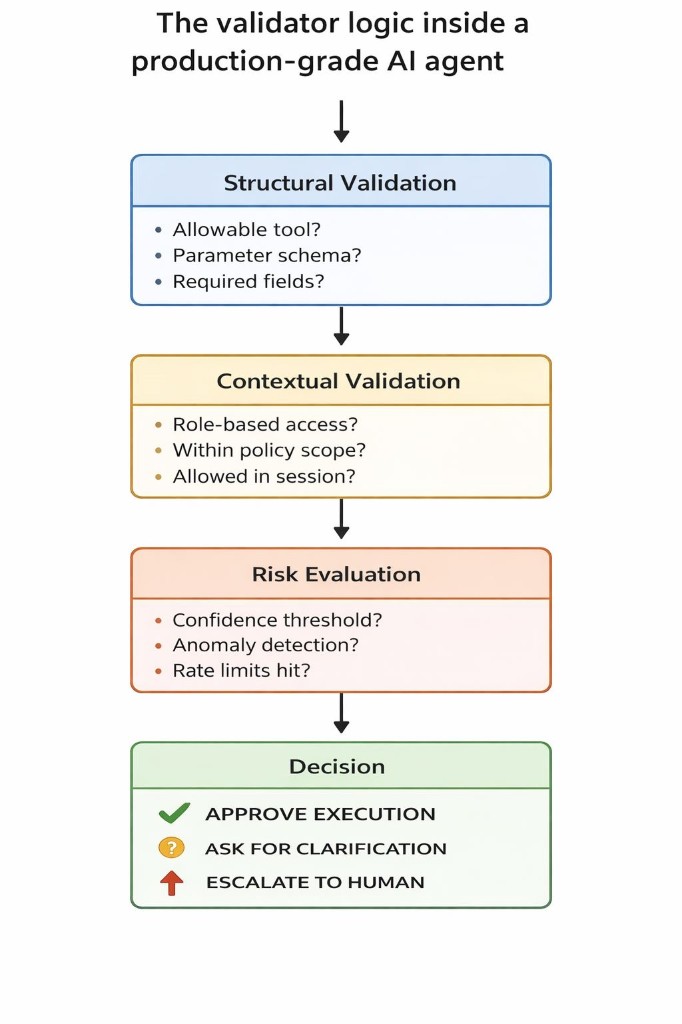
In production systems, a validator is not just a boolean check, it’s a layered decision engine.
A simplified structure looks like this:
Layer 1 – Structural Validation
- Is the tool name allowed?
- Do parameters match the schema?
- Are required fields present?
Layer 2 – Contextual Validation
- Does the user have the required role?
- Is this action allowed in this session context?
- Is the data scope within policy?
Layer 3 – Risk Evaluation
- Confidence threshold met?
- Anomaly detection triggered?
- Rate limits exceeded?
Layer 4 – Decision
- Approve execution
- Ask for clarification
- Escalate to human
The insight: Validation is not a single gate, it’s a layered risk model.
That’s what transforms AI agents from experimental systems into production infrastructure.
How are others structuring layered decision logic in agent architectures?