Production AI Patterns · #14 · 2026-03-25 · AI · Agents · Architecture
The God Agent is dead. Long live multi-agent routing
Enterprise scale needs specialized agents and routing—not one omniscient God Agent.
We’ve spent the last 13 posts building a production-grade AI agent.
It works beautifully. Until the system scales.
What happens when your enterprise agent needs:
- 50+ tools
- Multiple isolated databases
- Complex, multi-step workflows
- Cross-domain business logic
If you stuff all of that into one Orchestrator prompt…
The system collapses.
This is where most demo architectures fail.
Demo Architecture — The God Agent
One agent. One massive prompt. All the tools.
Everything is shoved into a single context window.
Result:
- Wrong tool calls
- Hallucinated data
- Context overflow
- Unpredictable execution
The bigger the prompt, the less reliable the agent.
Production Architecture — Supervisor & Worker Pattern
Enterprise systems don’t rely on a single monolithic service.
They use specialized components.
Production AI should do the same.
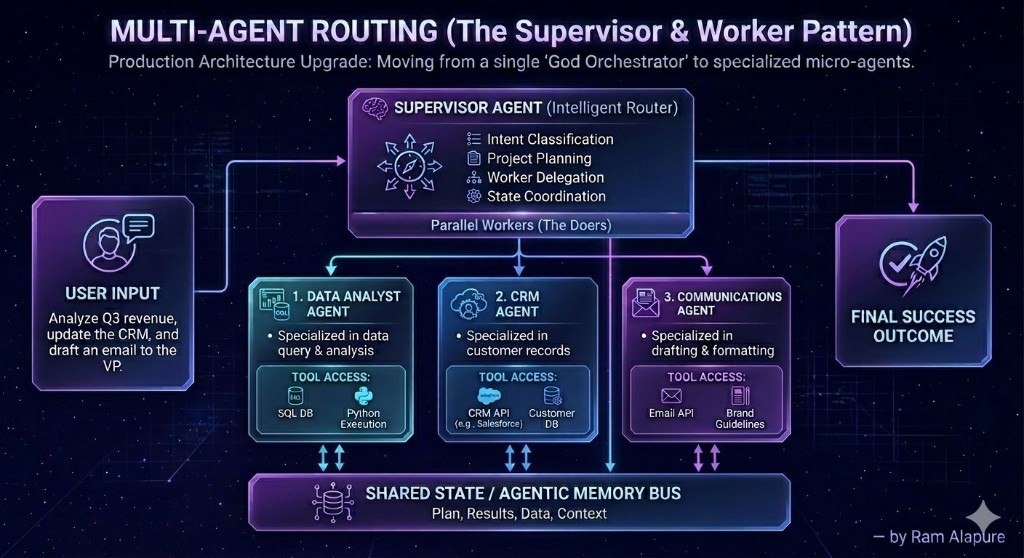
Instead of one God Agent, we build a Supervisor + Worker architecture.
1. Supervisor Agent (The Router)
The supervisor does not execute tools, its only job is to:
- Classify user intent
- Break the task into steps
- Route work to the right agent
- Coordinate the shared state
It is the control plane.
Flow: User → Supervisor → Workers → Supervisor → Result.
2. Worker Agents (Specialized & Narrow)
Each worker has a narrow prompt, a small toolset, and a clear responsibility.
For example: “Analyze Q3 revenue, update the CRM, and email the VP.”
- Data Analyst Agent → SQL + Python only
- CRM Agent → CRM APIs only
- Communications Agent → Email + Templates only
Fewer tools = fewer mistakes.
Narrow prompts scale infinitely better than giant prompts.
3. Shared State / Agentic Memory Bus
Workers don’t talk to each other directly.
(That causes infinite loops).
Workers write their results to a shared state.
The Supervisor reads that state and decides the next step.
Worker → State
State → Supervisor
Supervisor → Next Worker
This keeps the system controlled. Not chaotic.
The Architecture Rule
One agent → Demo
Multi-agent routing → Production
Big prompts → Unstable
Narrow agents → Predictable