Production AI Patterns · #16 · 2026-04-18 · AI · Agents · Architecture
Stop asking your LLM to behave
Security must be a decoupled AI Firewall—not a system prompt asking the model to behave.
In a demo, a system prompt is enough.
In Enterprise Production, a system prompt is a liability.
If your defense against prompt injection or PII leakage is just a “Please don’t do this” instruction, you aren’t building architecture. You’re building on hope.
The Enterprise AI Firewall Pattern
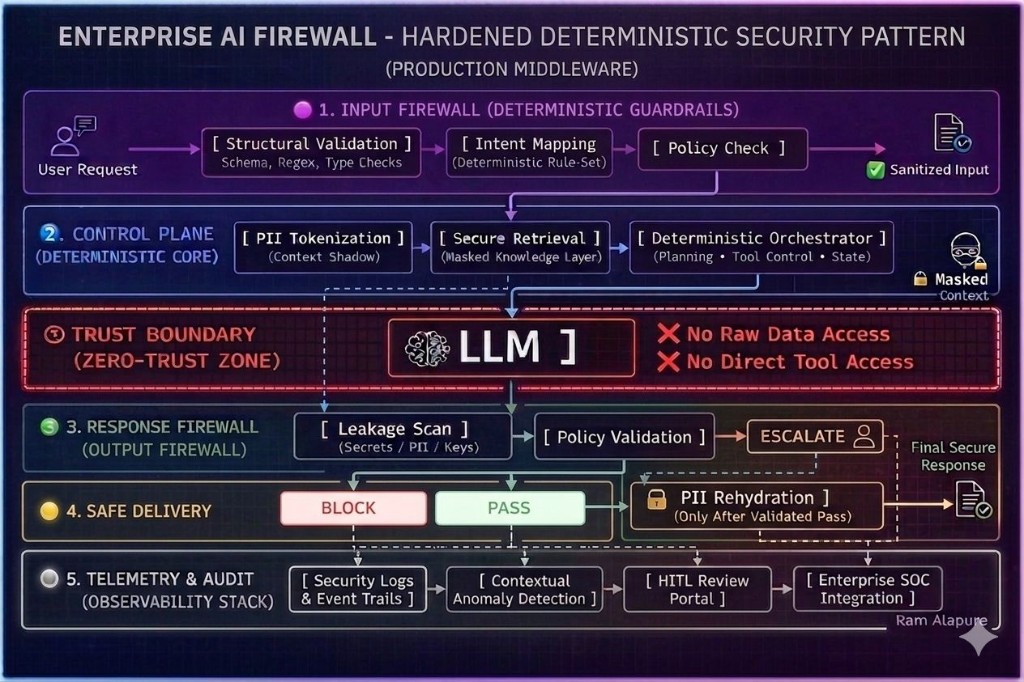
To move to a deterministic system, security must be a decoupled architectural layer, not a prompt. By isolating the LLM in a “Zero-Trust Zone,” we move from probabilistic “vibes” to architectural guarantees.
The 5-Tier Deterministic Security Pattern
-
Input Firewall (Deterministic Guardrails)
- Structural Validation: Use Schema and Regex checks to enforce data types before they reach the model.
- Intent Mapping: Requests are cross-referenced against a Deterministic Rule-Set. If the intent isn’t authorized, the request is killed before it ever touches the LLM.
-
Control Plane (The Deterministic Core)
- Context Shadow: PII Tokenization swaps sensitive data for tokens (e.g.,
USER_88). - Secure Retrieval: The LLM never sees your “raw” database. It only interacts with a Masked Knowledge Layer.
- Context Shadow: PII Tokenization swaps sensitive data for tokens (e.g.,
-
Output Firewall (The Guard)
- Leakage Scanning: Real-time scanning for Secrets, PII, or API keys in the generated response.
- Policy Validation: Cross-checking the output against enterprise compliance rules.
-
Safe Delivery (The Decoupled Rehydration)
- Conditional Logic: PII Rehydration happens only after a validated ‘Pass’ signal. We never trust the LLM to handle raw PII in its internal reasoning space.
-
Telemetry & Audit (The Observability Stack)
- Centralized Logging: Every block, pass, and escalation is fed into your Enterprise SOC.
- Anomaly Detection: Real-time monitoring of policy usage to detect evolving jailbreak patterns.
The Architect’s Take
Security is Middleware.
Compliance teams and CISOs don’t care about “good prompts”—they care about verifiable controls. By wrapping the untrusted LLM in a deterministic firewall, you provide the safety audit trail required for regulated industries like banking and healthcare.
How are you “hardening” your agentic workflows for production?