Production AI Patterns · #11 · 2026-03-17 · AI · Agents · Architecture
10 architecture lessons from building production-grade AI agents
Ten architecture lessons from building planner–orchestrator–validator agents for production environments.
10 Architecture Lessons from Building Production-Grade AI Agents
Over the last few weeks, I shared a series of posts about designing production-grade AI agents.
Not demos.
Not toy workflows.
Real systems with control, safety, and failure handling.
While writing these posts, one thing became clear:
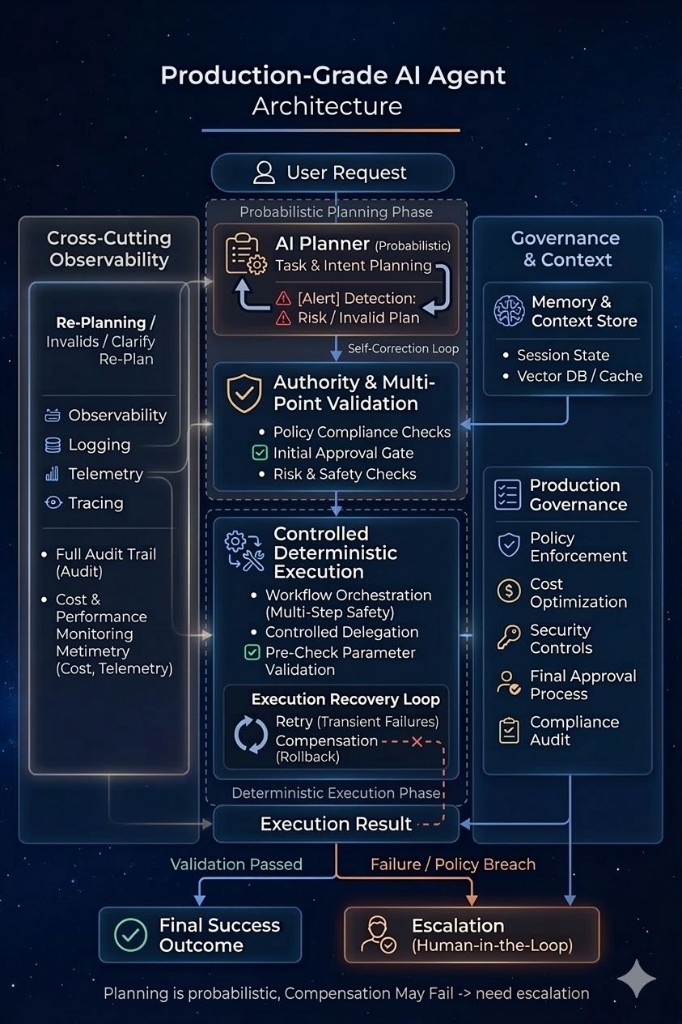
Production agents are not just LLM calls, they are layered systems.
Here is a quick recap of the first 10 posts in the series:
- Demo Agents vs Production Agents — Production agents need deterministic control layers
- Guard Layer Pattern — LLM output should pass through a safety / guard layer
- Validation Layer in Agent Systems — Agents should validate tool calls before execution
- Agents are Distributed Systems — The failure mode is rarely “bad text”, it’s broken state
- Agent Failures Need Observability — You cannot fix what you cannot trace
- Retry vs Compensation — Retries handle transient failures, not state rollback
- Compensation + Escalation Pattern — Compensation may fail → need escalation
- Illusion of Autonomous Agents — Production agents run inside controlled boundaries
- Planner Risk in Agent Systems — Wrong plans can break the system
- Authority Boundaries in Agents — Agents should not execute everything they plan
Across these posts, a pattern emerges. Production AI agents usually need:
- Planner
- Orchestrator
- Authority Boundary
- Validator
- Controlled Execution
- Retry / Compensation
- Escalation
- Observability
Planning is probabilistic. Execution must remain deterministic.
I’ll continue the series with deeper topics on production agent architecture.
If you’ve been following the journey — thank you. If you’re new, this post is a good place to start.
Let me know what you think of the architecture diagram in the comments!